
Membrane Filter Press Manufacturer Guide to High-Performance Filtration
2026-10-29
Getting a filter press to deliver low-moisture cakes without endless cycle times isn't a given—it takes the right membrane design and operating know-how. In this guide, we look at what separates a high-performance membrane filter press from an average one, drawing on field insights from Sinou and practical tips you can apply on your next dewatering project.
Why Membrane Plate Stacks Change the Economics of Solid-Liquid Separation
The shift to membrane plate stacks rewrites the cost equation in solid-liquid separation by dramatically cutting cycle times and energy use. Traditional chamber plates rely on hydraulic pressure alone to squeeze out moisture, often leaving a wet cake that demands further drying. Membrane plates add a flexible barrier that inflates after the initial feed, applying a second, uniform squeeze across the entire chamber. This extra mechanical action pushes out significantly more liquid in the same footprint, reducing the need for downstream thermal drying. Operators see lower utility bills and shorter batch times without expanding the filter press.
Beyond energy savings, the economics improve through higher throughput per square meter. With a more complete dewatering step, each cycle yields a drier, denser cake, so fewer cycles are needed to process the same volume of slurry. This means existing filter presses can absorb more capacity, delaying capital expenditure on additional equipment. Maintenance also drops because the squeezing phase is more controlled, minimizing uneven cake buildup and reducing wear on filter cloths and plates. For plants facing tightening disposal costs, the lower moisture content translates directly into lower hauling and tipping fees per ton of solids.
The financial case gets even stronger when considering product recovery and water reuse. Membrane squeezing recovers more filtrate, which in many processes contains valuable dissolved solids or can be recycled back into the process stream. Less moisture in the cake also improves handling characteristics, cutting labor and equipment time for cake discharge and transport. Over the life of a press, these operational gains compound, making the higher upfront price of membrane plates pay for itself often within months, not years.
Selecting Membrane Materials and Recess Depth for Difficult Slurries
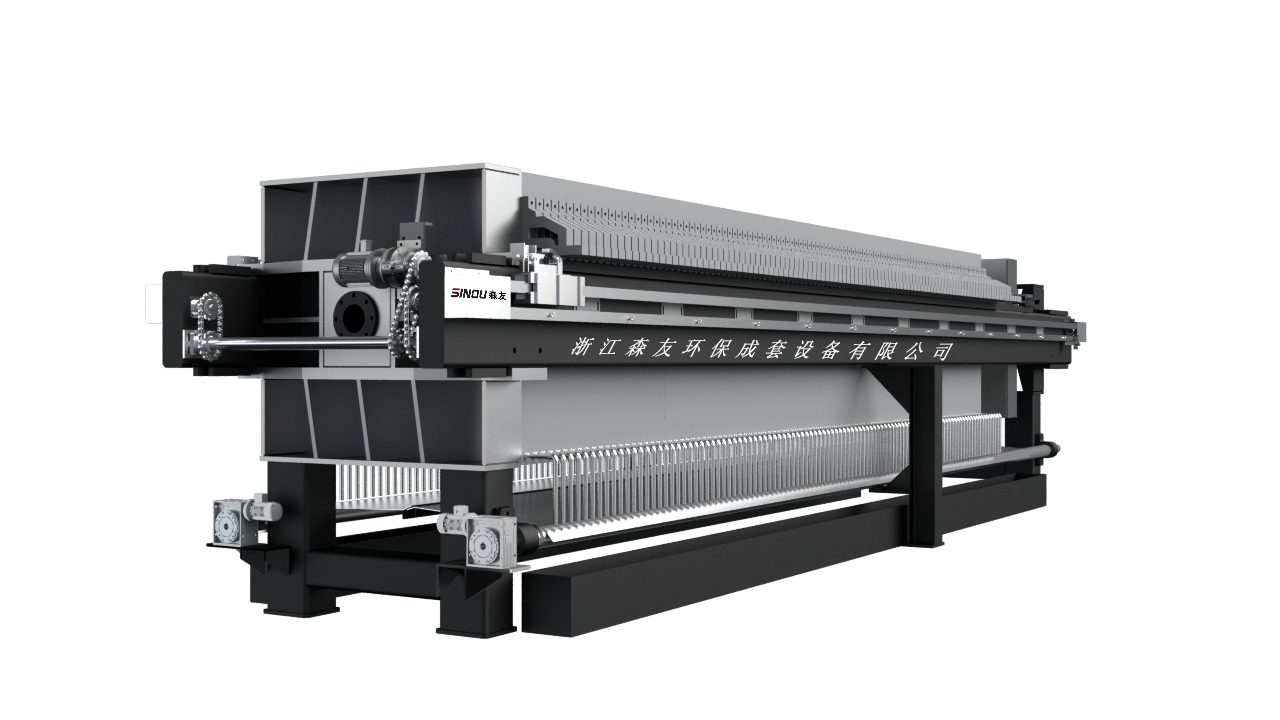
Difficult slurries—those with high viscosity, fine particles, or compressible solids—demand careful pairing of membrane material with recess depth. A membrane that's too stiff won't flex uniformly into the cake, leaving wet pockets, while an overly soft one may balloon into the recess and tear under repeated cycles. For abrasive or chemically aggressive slurries, EPDM and NBR are common starting points, but many plants have shifted to thermoplastic elastomer (TPE) blends for better fatigue resistance and cleaner release.
Recess depth is often treated as an afterthought, but it directly controls cake thickness and washing efficiency. Shallow recesses (25–30 mm) work well for fast-filtering, low-solids slurries, but difficult slurries typically need deeper chambers—40 mm or more—to prevent premature blinding and allow the cake to build without choking the feed. However, going too deep increases cycle time and can cause uneven pressure distribution, so the choice should match the expected cake compressibility and solids loading per cycle.
Field adjustments matter just as much as initial selection. Start with a mid-range recess depth and a membrane rated for the slurry's pH and temperature, then run a short trial batch while monitoring filtrate clarity and cake moisture. If the cake sticks or the membrane shows signs of localized wear, change one variable at a time—usually recess depth first, then membrane hardness—until the discharge is consistent and the press reaches target pressure without spiking.
Feed and Fill Profiles That Prevent Uneven Cake Formation
Uneven cake formation is rarely a random event. It usually traces back to the first few seconds of slurry delivery. If the feed pressure spikes too early or the flow arrives in a single hard surge, fines get driven into one corner while coarser particles stay near the inlet. A better approach is to use a controlled feed profile that starts low and climbs gradually. This lets the initial layer form across the entire filter area before the bulk of the solids arrive.
Fill profiles matter just as much once the chamber starts to pack. Holding a fixed flow rate while the pressure drop rises tends to force liquid through whatever paths are still open, which deepens existing unevenness. Ramping down the fill rate as the cake thickens keeps the driving force more balanced from plate to plate. In practice, many operators find that a short pause at half fill works better than any continuous curve, giving the cake a moment to consolidate before the final push.
Small changes in pump control can have an outsized effect. Varying the acceleration of the feed pump, adding a brief recirculation step, or switching from a constant-speed to a variable-frequency drive can all help maintain a uniform cake. The target is the same across all these methods: keep the solids arriving slowly enough to spread out, but quickly enough to avoid settling in the piping.
Tuning Squeeze Cycles Without Overstressing the Membrane
Finding the right squeeze cycle is less about hitting an exact number and more about reading how the membrane responds. Start by shortening the pressure dwell time in small increments while watching the transmembrane pressure curve for sharp recovery spikes. A spike often means the membrane is being forced back into shape too quickly, so backing off the squeeze duration by a few milliseconds can ease that stress without sacrificing throughput.
Another practical lever is to adjust the release ramp rather than the squeeze itself. Many setups default to a near-instant pressure drop, which can cause micro-tears at the membrane edges. Introducing a controlled, slightly slower release phase distributes deformation more evenly and gives the material a moment to relax. This approach tends to produce fewer fatigue-related failures over long runs.
It also helps to track cycle-to-cycle consistency instead of relying on occasional spot checks. If the peak pressure varies by more than a few percent between cycles, the tuning is likely too aggressive for the membrane's elastic range. Small, repeatable adjustments based on logged pressure values will keep the process stable without pushing the membrane into unnecessary strain.
Detecting Early Signs of Plate Pack Wear Before Leaks Appear
Plate pack wear rarely announces itself with a dramatic failure. Instead, it leaves subtle clues that are easy to dismiss if you only watch for drips or pressure drops. The first place to look is the tightening dimension—measure the actual compressed stack height against the original specification. A reduction of even a few millimetres, especially on a freshly torqued unit, points to gasket creep or plate corner deformation. Listen too: a soft ticking sound during thermal cycling often means plates are shifting microscopically, rubbing off protective edge coatings before any visible crack forms.
Don't ignore changes in fluid behaviour that seem minor. A gradual rise in approach temperature across the heat exchanger, combined with slightly uneven outlet temperatures between passes, can indicate localised bypassing caused by worn plate chevrons or a loss of edge seal contact. Pull a small sample of process fluid and check for trace metals or gasket particles—early abrasion sheds fine debris long before a through-wall leak develops. Visual inspection through the end plate or during a scheduled short shutdown remains your most reliable tool: look for polished bright spots on plate crowns, thinning at the contact points, or a dull, pitted surface where the original pressed pattern has been flattened.
Finally, track maintenance intervals rather than relying on time-based replacements alone. Log the torque required to achieve a leak-free seal during each reassembly. If you need progressively more torque to stop weeping, or if plates repeatedly loosen after a few hundred thermal cycles, the pack is losing its elastic memory. Catching these signs early lets you rotate plates, replace individual damaged units, or re-gasket before a pinhole forms—saving the cost of emergency downtime and the mess of a full-blown leak.
Instrumentation Upgrades That Turn Press Data into Process Control
Modern stamping presses already collect plenty of numbers—stroke counts, tonnage peaks, die temperatures. The problem is that most of these figures sit in a historian or a maintenance log, telling you what happened after the fact. The real shift happens when you upgrade sensors and edge devices to feed live signals back into the press controller, so a dip in blank holding force or a spike in vibration can adjust ram speed or cushion pressure within the same cycle. That closed loop turns raw press data from a passive record into an active driver of part quality.
A practical first step is replacing basic analog transducers with smart, self-diagnosing units on critical zones: die cushion pins, bed strain gauges, and slide parallelism sensors. These don't just output a voltage—they timestamp, filter, and flag anomalies locally. Tie them to a compact PLC or an I/O link that reads at sub-millisecond intervals, and you create a feedback path that can hold tonnage within a narrow band even as material thickness wanders. Operators stop chasing scrap after a coil change and start trusting the press to correct itself.
Beyond individual loops, upgraded instrumentation enables cross-press learning. When identical sensor packages run on a line of presses, you can compare signature curves for the same die set and spot a deteriorating bearing or a misaligned bolster before it shows up in dimensional checks. The data becomes a control input not just for one machine, but for scheduling maintenance, adjusting incoming blank specs, and fine-tuning lubricant application. That's the difference between monitoring a press and actually steering it.
FAQ
The key difference lies in the flexible membrane installed on the filter plates. After the initial filtration cycle fills the chambers with slurry, the membrane can be inflated with liquid or air to squeeze the filter cake, reducing moisture content and improving solids discharge. This secondary pressing step is not available in standard fixed-chamber presses.
Match the membrane polymer to the chemical environment and operating temperature. Polypropylene works for many acids and alkalis up to around 80°C, while EPDM or NBR may be needed for oily or high-temperature streams. Always request chemical compatibility charts from the manufacturer and consider a pilot test if the feed composition varies.
Inspect membrane integrity regularly with a low-pressure air test, check plate alignment and hydraulic cylinder seals, and clean cloths before they blind. Replace any membrane showing cracks or delamination immediately. Keep a log of cycle times and pressures; a gradual rise in cycle time often signals cloth wear or feed pump issues.
Yes, but proper sizing matters. For slurries with high solids content, choose a press with larger chamber depth and automated plate shifting to speed up cake release. Pre-thickening the feed or using a diaphragm pump with consistent pressure can reduce cycle frequency. The membrane squeeze step also shortens drying time, so overall throughput stays high.
The biggest benefit is drier filter cakes, which lowers disposal costs and hauling weight. It also improves filtrate clarity by compacting the cake and reducing channeling. In many wastewater plants, membrane pressing cuts cycle time by 20–30% compared to non-membrane presses, and the cakes often meet landfill moisture limits without additional drying.
Uneven cakes usually point to uneven feed distribution, worn plate gaskets, or clogged cloths. Check that the feed manifold is not partially blocked and that all plates are seated correctly. If some chambers fill before others, the slurry may be settling in the feed line. Also verify that the membrane inflation pressure is uniform across all plates; a leaking membrane in one chamber will reduce squeeze efficiency there.
Plate design affects flow distribution, cake washing efficiency, and membrane life. Drip-tray or gasketed plates with well-designed drainage ports prevent bypass and allow uniform pressure across the cake. Recessed chamber depth should match the expected cake thickness. For difficult slurries, plates with corner feed and membrane channels that promote turbulence help reduce blinding and improve cycle consistency.
It can be. Although the initial capital cost is higher than a conventional press, the savings from drier cakes, reduced labor for cake handling, and shorter cycles often pay back within one to two years in dewatering applications. For smaller operations, a compact model with manual plate shifting and a simple hydraulic system can keep costs down while still delivering the benefits of membrane squeezing.
Conclusion
Switching to membrane plate stacks often shifts a project's cost curve more than any single mechanical upgrade. The squeeze phase adds a second compression stage that drives residual moisture out of the cake, cutting drying or hauling costs downstream. For difficult slurries, the real leverage sits in selecting the right membrane material and recess depth. A thin, flexible membrane may handle slow-filtering, high-clay feeds better than a thicker one that looks tougher on a datasheet. Feed and fill profiles matter just as much: ramping pressure too early or flooding the chamber unevenly creates soft spots, then the membrane pushes against an already uneven cake and the cycle time drifts upward.
Squeeze tuning requires balancing water removal against membrane fatigue. Running a membrane at its maximum rated pressure on every batch may look aggressive, but it often shortens plate pack life without a meaningful gain in cake dryness. Operators who track subtle changes—slightly longer fill times, a drop in filtrate clarity, or a gradual rise in feed pressure at the same flow—can spot plate pack wear before visible leaks. Adding a few well-placed pressure transmitters and a flowmeter turns the press from a batch device into a process control tool. Trends in squeeze pressure decay and fill volume usually reveal worn cloths, misaligned plates, or a failing membrane long before the floor gets wet.
Contact Us
Contact Person: HaiYan
Email: [email protected]
Tel/WhatsApp: +86 18957325588
Website: https://www.senyoubeton.com/