
China CNC Lathe Machine Buying Guide for Precision Workshops
2026-09-19
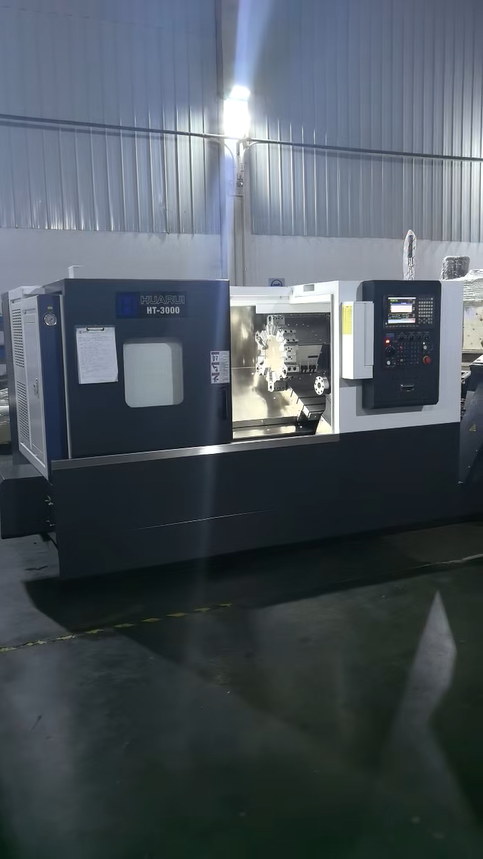
Precision machining demands more than just a spec sheet—it demands repeatability under real cutting loads. If you're sourcing a China CNC lathe machine for your workshop, the sheer number of options can hide serious differences in spindle rigidity, thermal stability, and after-sales support. This guide cuts through the marketing noise to show you exactly what to inspect before signing a purchase order. Drawing on hands-on experience from WINNRUI CNC, we'll walk you through the key performance indicators that separate a true precision lathe from a costly compromise.
Where Precision Starts: Spindle Runout and Thermal Drift You Can Actually Measure
Most spindle specs read like marketing fiction—runout under a micron, thermal drift “negligible.” Then you clamp a test bar, fire up the machine, and watch the indicator wander as the bearings warm. Real precision doesn’t start on a datasheet; it starts with measuring what your spindle actually does on your floor, under your loads, at your speeds.
Runout is the easy part to measure badly and the hard part to measure well. A tenths indicator on a ground arbor tells you something, but not the whole story. What matters is dynamic runout—how the tool tip orbits once cutting forces and RPM stack up. Static checks miss bearing clearance shifts, uneven preload, and taper fretting that only show up when metal meets metal at 20,000 revs.
Thermal drift is the silent killer of tight tolerances. Your spindle grows, the housing tilts, and the effective tool length changes—all before the coolant temp stabilizes. Instead of guessing with “warm-up cycles,” map the drift: run a 30-minute cutting simulation, log Z-axis shift every two minutes, and compensate from real numbers. That’s the difference between holding a band and hoping for one.
Reading Between the Spec Sheets: What Chinese Builders Don't Always Advertise
Spec sheets from Chinese builders often read like a wish list of modern features: ample battery range, fast charging, and a cabin stuffed with screens. Yet once you slide behind the wheel, the numbers start to feel less generous. Real-world range can dip by 20% or more in cold weather, and the promised charging speed rarely materializes unless you find one of the few ultra-fast stations that actually work. It's not outright deception—just the gap between laboratory conditions and your daily commute.
What rarely makes it onto the brochure is how the car ages. After two or three years, some models develop rattles in the dashboard, the infotainment system slows to a crawl, and the suspension starts to feel looser than the early test drives suggested. Build quality varies not just between brands, but between batches from the same factory. A friend's car might feel solid while another one delivered a month later has misaligned panels and a frunk that needs a firm slam. These are the things you only learn from owner forums and long-term reviews.
Then there's the software. Many Chinese EVs ship with impressive hardware—lidar, multiple cameras, powerful chips—but the driver assistance features arrive half-baked, with updates promised later. Sometimes later never comes, or the update arrives only for the next model year and not yours. The company might advertise over-the-air updates, but the frequency and quality vary wildly. You could be left with a car that has the bones of advanced autonomy but the brain of a hesitant learner, all while the brand moves on to its next new thing.
Controller Choices That Outlive the Initial Quote
Choosing the right controller often comes down to more than just the sticker price or the spec sheet at the moment of purchase. Many buyers focus on immediate needs—compatibility with a current console, a particular grip style, or a flashy feature—but the real value emerges months or even years later. A well-built controller with modular components, remappable inputs, and durable switches can adapt as your gaming habits shift, sparing you the cost and hassle of replacing an entire unit when one small part wears out or a new title demands a different layout.
Consider how your preferences evolve: a player who starts with casual platformers might later dive into competitive shooters, where adjustable trigger stops and back paddles become essential. If the controller you picked allows for firmware updates, swappable thumbsticks, or interchangeable D-pads, it can grow with you. This kind of forward compatibility isn't just about hardware longevity—it's about avoiding the trap of buying a new controller every time a new genre captures your interest. The initial quote might look higher for a controller with these options, but the cost per hour of use drops dramatically when you're not replacing it every year.
Durability also plays a quiet but critical role. Cheap controllers often fail at the analog stick or shoulder button within months, leading to repeated purchases that quickly exceed the price of a premium option. A controller with hall-effect sensors, metal internal parts, and a reputation for surviving heavy use can remain reliable long after the warranty expires. When you choose a controller based on how it will serve you in two or three years—not just how it feels on day one—you make a decision that truly outlives the initial quote.
Cast Iron Isn't Just Cast Iron: Bed Rigidity Tests That Matter
The blanket term "cast iron" hides a spectrum of alloys with wildly different stiffness and damping behavior. Gray iron, the classic choice for machine beds, owes its vibration-absorbing properties to graphite flakes that interrupt stress waves, but those same flakes make it relatively brittle and lower in tensile strength. Ductile iron, with its spheroidal graphite, trades some of that damping for higher rigidity and toughness. A bed poured from low-grade gray iron with excessive porosity will flex under loads that a well-compacted ductile iron bed shrugs off, so checking the actual material spec matters as much as the marketing label.
Real rigidity tests go far beyond a simple "push on it and see if it moves" check. Static stiffness measurements apply a known force at the spindle or table and record deflection with dial indicators or laser displacement sensors, yielding a N/µm figure that separates serious machine tools from toys. Dynamic testing using impact hammers and accelerometers maps the bed's natural frequencies and mode shapes, revealing whether resonance peaks sit close to common spindle speeds. A bed that rings like a bell at 800 Hz will chatter on every face-milling pass, while one with broad, low-amplitude modes from quality cast iron will cut cleanly through the same operation.
The practical payoff of rigorous rigidity testing shows up in surface finish and tool life, not just spec sheets. A bed that deflects 20 microns under a 2 kN cutting load will translate that movement directly into dimensional errors on the workpiece, especially during interrupted cuts or when the tool enters and exits the material. Machine builders who publish their measured stiffness curves and modal analysis results—not just a vague "heavy-duty cast iron construction" claim—give you a basis for predicting real-world performance. Before buying, ask for the deflection under a representative cutting force and the first three natural frequencies; those numbers expose the difference between a bed that merely looks solid and one that actually behaves solid when the chips start flying.
Local Support Reality: Getting Parts and Service After the Wire Transfer
Once the wire transfer hits their account, the tone of the conversation shifts. The sales team that answered emails within hours before payment now takes days to acknowledge a missing bolt or a faulty sensor. You're not dealing with a local distributor anymore—you're chasing someone eight time zones away who has already booked the revenue. If you're lucky, they'll point you to a PDF parts list and wish you well.
Real local support usually means you becoming your own technician. Most imported machines don't have a nearby service center, and the few so-called authorized shops are often just general repair outfits that have never seen your model. Ordering spare parts turns into a test of patience: you pay upfront, wait for a shipping window, and hope customs doesn't hold the package. A $40 circuit board can take three weeks and cost more in freight than the part itself.
The practical workaround is to ask hard questions before you wire the money. Request a written inventory of critical spares that can ship with the machine, get a direct contact for after-sales, and verify there's an English-speaking engineer reachable by phone or video. If a seller resists those requests, that's your answer. Once the funds leave your account, the leverage leaves with them.
Bring Your Own Part: The Only Acceptance Test That Counts
A part that fits is not a promise; it's a verdict. When someone brings their own component to the table, the real test isn't whether it meets a spec sheet or survives a stress test in isolation. It's whether it mates with the rest of the assembly without a whisper of complaint.
This standard cuts through the noise of meetings, mockups, and hypotheticals. A designer can draft a perfect interface, a supplier can ship a part with tight tolerances, and a project manager can declare everything on track. None of that matters until the physical object is placed against its counterpart and you hear the click, see the flush seam, or feel the absence of play.
The beauty of "bring your own part" is that it removes interpretation. No one argues about whether a drawing was read correctly. No one debates if the material choice was wise. The part either works with the existing whole, or it doesn't. And when it doesn't, the failure is immediate, honest, and impossible to spin into a status update.
FAQ
Focus on the machine's thermal stability and way system. Ask for a thermal drift test under load, not just brochure accuracy. Box ways or high-rigidity linear guides with preloaded ballscrews usually beat standard configurations when holding micron-level tolerances.
Request a laser interferometer report and a ballbar test performed on your specific machine before shipment. Better yet, ask for a video of the machine cutting a test piece in hardened steel, with the CMM inspection report attached. Never accept a generic specification sheet.
Custom configurations often deliver more value for precision work. Specify the spindle bearings, Japanese or European brands, the grade of ballscrews, and the control system. Chinese builders regularly accommodate these changes for a modest premium.
Rigging, import duties, and the cost of correcting small defects locally. Also factor in travel if you plan to do a pre-shipment inspection. Many buyers skip the inspection and later pay more for realigning the turret or replacing substandard coolant lines.
Ask for a component traceability list. Which brand of linear guides? What grade of spindle bearings? Who makes the chuck? Then verify the serial numbers on those parts during a factory video tour. This simple step weeds out generic suppliers.
Expect remote diagnosis via video call, with parts shipped by air for urgent failures. Some larger builders have local service partners in North America or Europe, but don't assume this. Ask for a response-time commitment in writing, and test their English technical support before purchase.
Standard machines might ship in 30 to 45 days, but customized precision lathes can take 90 to 120 days. Ocean freight adds another 4 to 6 weeks depending on port. Plan your production around that, and consider air freight for critical parts later.
Yes. The Yangtze River Delta around Shanghai and Zhejiang has a dense cluster of machine tool builders, many with experience exporting to strict markets. Northern China and Guangdong also have capable shops, but the supply chain for precision components tends to be more mature in the east.
Conclusion
Precision workshops shopping for a Chinese CNC lathe quickly learn that the numbers on a brochure rarely tell the whole story. A spindle rated at 0.003 mm runout might pass a quick bench test but drift noticeably once the machine reaches operating temperature. Smart buyers measure runout under load, track thermal growth over a two-hour cycle, and ask the builder for a warm-up curve rather than a cold-start spec. The same skepticism applies to spec sheets that leave out way wiper quality, ballscrew preload values, or the actual grade of linear guides. Many Chinese builders will happily advertise a Siemens or Fanuc control option, but the real long-term cost hides in the PLC ladder logic, I/O expansion ports, and whether the control firmware will still receive patches five years after installation. A cheap proprietary controller can turn a lathe into an orphaned paperweight, so it's worth paying for a mainstream control with a local service network.
Bed rigidity is another area where shortcuts hide in plain sight. A thick-looking casting can still be riddled with stress risers or poured from recycled scrap with inconsistent damping. Asking for a three-point leveling test, a dynamic stiffness plot, or cutting a heavy interrupted cut on a demo machine reveals more than any hardness certificate. Once the wire transfer clears, support becomes the deciding factor: who stocks spindle bearings, ballscrews, and servo drives in your region, and how quickly can they ship a replacement turret seal? The only acceptance test that matters is bringing your own part—preferably one with tight bores, threads, and a surface finish requirement—and running it on the actual machine you intend to buy, not a factory demo unit. If the builder hesitates to let you run your own program or measure your own part, walk away.
Contact Us
Contact Person: Tim
Email: [email protected]
Tel/WhatsApp: +86 15522553731
Website: https://www.winnrui-cnc.com/